On Fridays I share articles/resources about broad cultural, societal and theological issues. Be sure to see the explanation and disclaimers at the bottom. I welcome your suggestions. If you read something fascinating please pass it my way.
Things Glen Found Interesting
- The homeless who help themselves get a needed lift (Kevin Kelly, San Jose Mercury News): “LifeMoves, formerly known as InnVision Shelter Network, is a 44-year-old [Bay Area] nonprofit that specializes in getting individuals into temporary housing and on a path to permanent housing. It claims a 93 percent success rate of getting homeless families housed and self-sufficient, and a 72 percent success rate with individuals. There is just one caveat: People who receive assistance — referred to as clients — must demonstrate a willingness to better themselves.”
- Related: 5 Harsh Realities Of Homeless Camps Nobody Talks About (Evan Symon, Cracked): “If you live in a major American city, you’ve probably seen your fair share of homeless camps. They usually crop up in empty lots, parks, and Big Rock Candy Mountains. City governments generally have them torn down and cleaned up whenever they can. Leaving aside whether or not that’s the right way to address homelessness, somebody has to do the work of cleaning those places up. Our source, Carol, did just that.”
- People for sale: Where lives are auctioned for $400 (Nima Elbagir, Raja Razek, Alex Platt and Bryony Jones, CNN). There is a text story at the link, but the embedded seven minute video is worth watching, especially the first four minutes. This is a horrifying development in the migrant crisis — slave auctions.
- How To Think About Vladimir Putin (Christopher Caldwell, Imprimis): “When Putin took power in the winter of 1999–2000, his country was defenseless. It was bankrupt. It was being carved up by its new kleptocratic elites, in collusion with its old imperial rivals, the Americans. Putin changed that…. Russian people not only tolerate him, they revere him. You can get a better idea of why he has ruled for 17 years if you remember that, within a few years of Communism’s fall, average life expectancy in Russia had fallen below that of Bangladesh. ” This is a slightly older article, and so his comments about Russia’s role in the U.S. election aren’t very current. His broader observations are worth pondering.
- The Supreme Court hears arguments about the Christian baker who refused to bake a cake for a gay wedding on Tuesday. Lots of people are writing about it.
-
- Against the baker: The Christian Legal Army Behind ‘Masterpiece Cakeshop’ (Sarah Posner, The Nation): “On December 5, with the full force of the United States government behind it, ADF will be asking the Supreme Court to carve out yawning exemptions from civil-rights laws for conservative Christians.” (this is less about the case and more about the firm representing the baker — it’s a hit piece but is full of interesting info)
- Against the baker: The Masterpiece Cakeshop Case Is Not About Religious Freedom (Jennifer Finney Boylan, New York Times): “But Masterpiece has nothing to do with religious freedom. It’s about enshrining a freedom to discriminate. Historically, religious exemptions from the law have occasionally been granted to protect the person who holds the belief. But this case is different, in that it gives an individual the right to harm someone else. And that’s what the Masterpiece case is about: It would give individuals the right to discriminate.” The author is an English professor at Barnard College.
- Against the baker: The Gay Wedding Cake Case Isn’t About Free Speech (Andrew Koppelman, The American Prospect).”It is merely telling him that if he sells any products to heterosexual couples, he must sell the same products to same-sex couples. He is free to refuse to write ‘Support Gay Marriage’ on any cakes that he sells, so long as he refuses that to both gay and heterosexual customers. So this is an easy case. Phillips should lose.“ The author is a law professor at Northwestern. This is the strongest argument I have read against the Christian baker.
- For the baker: Stop Misrepresenting Masterpiece Cakeshop (David French, National Review): “Phillips isn’t discriminating against a protected class. I’ll repeat this until I’m blue in the face. He serves gay customers.”
- For the baker: The Christian Baker’s Unanswered Legal Argument: Why the Strongest Objections Fail (Sherif Girgis, Public Discourse): “Should an Islamophobic sect get to force Muslim caricaturists to sketch mocking images of the Prophet? Clearly not.” Disclaimer: Sherif was a roommate of one of our alumni and is an acquaintance of mine.
-
- Dueling perspectives on the family lives of blue state and red state Americans:
- Blue States Practice the Family Values Red States Preach (Nicholas Kristof, New York Times): “The liberal impulse may be to gloat: Those conservatives thunder about ‘family values’ but don’t practice them. But there’s also perhaps a measure of hypocrisy in the blue states. As Cahn and Carbone put it: ‘Blue family values bristle at restrictions on sexuality, insistence on marriage or the stigmatization of single parents. Their secret, however, is that they encourage their children to simultaneously combine public tolerance with private discipline, and their children then overwhelmingly choose to raise their own children within two-parent families.’” Kristof is a Pulitzer prize-winning journalist who was a Rhodes Scholar and is on the Board of Overseers for Harvard University.
- No, Republicans Aren’t Hypocrites on Family Values W. Bradford Wilcox and Vijay Menon, Politico): “In other words, even though Southerners in general are at greater risk of family instability than Northerners, Republicans in the South enjoy markedly higher levels of family stability than their fellow citizens—a family stability advantage that puts them above Democrats and independents in the North. Another way to put this: It’s blue and purple Americans in the South who are really pulling down family stability in the South, not red Americans.” Wilcox is a sociology prof at UVA, where Minon is also a grad student.
- We Didn’t Become Christians Because Of The Hucksters (Michael Wear, Fathom): “If the world criticizes the pride of someone who claims the name of Christ—or who won the votes of those who do—point them to Jesus, who was born into poverty, who instructed his followers to take the low position, and humbled himself on the way to the cross…. There is nothing so wrong with the poor example of Christians that can’t be solved by proclaiming the perfect example of Christ.”
- Stanford can take Junipero Serra’s name off its buildings, but it can’t purge him from its history (Charlotte Allen, LA Times): “The Main Quad, part of a master plan designed by landscape architect Frederick Law Olmstead, imitates Serra’s missions (with some Romanesque touches). Besides the Mall and the boulevard, other campus streets are named after his friar-disciples (Lasuén and Francisco Palóu), as well as José de Gálvez, the inspector general for New Spain who facilitated Serra’s missionary work in Alta California. If the Stanford activists aim to obliterate Serra’s presence from their campus, they’ve got their work cut out for them.” I didn’t know Serra’s influence was so pervasive at Stanford.
Things Glen Found Amusing
- Man Coming Out Of Year-Long Coma Excited To Catch Up On Humanity’s Progress (Babylon Bee): that poor, poor soul
- How to Save Money This Christmas
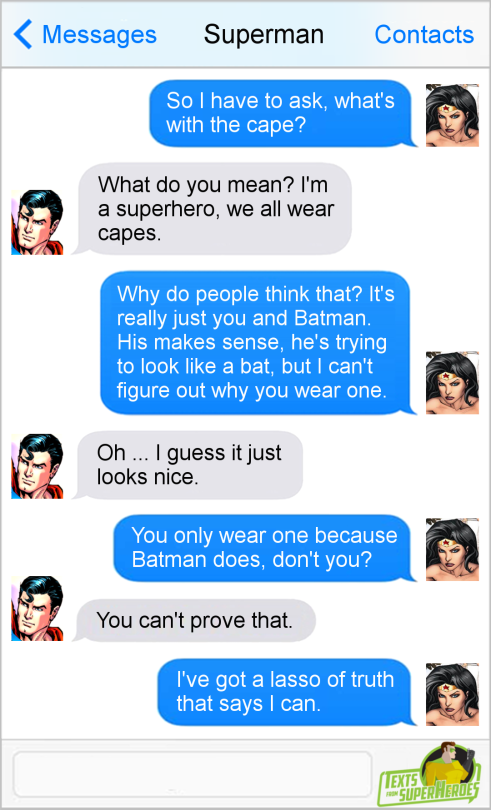
- Why Superman Wears a Cape (texts from superheroes)
- Let This Vanity License Plate Console You as Finals Draw Near (be encouraged — it is truer than you believe)
- What Is Even Happening in This Gif? trying to imagine the backstory hurts my brain
Things Glen Found Interesting A While Ago
Every week I’ll highlight an older link still worth your consideration. This week we have Letter To My Younger Self (Ryan Leaf, The Player’s Tribune): “Congratulations. You officially have it all — money, power and prestige. All the things that are important, right?… That’s you, young Ryan Leaf, at his absolute finest: arrogant, boorish and narcissistic. You think you’re on top of the world and that you’ve got all the answers. Well I’m sorry to have to tell you this, but the truth is….” Such a gripping letter. Highly recommended. (first shared in volume 99)
Why Do You Send This Email?
In the time of King David, the tribe of Issachar produced shrewd warriors “who understood the times and knew what Israel should do” (1 Chron 12:32). In a similar way, we need to become wise people whose faith interacts with the world. I pray this email gives you greater insight, so that you may continue the tradition of Issachar.
Disclaimer
Chi Alpha is not a partisan organization. To paraphrase another minister: we are not about the donkey’s agenda and we are not about the elephant’s agenda — we are about the Lamb’s agenda. Having said that, I read widely (in part because I believe we should aspire to pass the ideological Turing test and in part because I do not believe I can fairly say “I agree” or “I disagree” until I can say “I understand”) and may at times share articles that have a strong partisan bias simply because I find the article stimulating. The upshot: you should not assume I agree with everything an author says in an article I mention, much less things the author has said in other articles (although if I strongly disagree with something in the article I’ll usually mention it).
Also, remember that I’m not reporting news — I’m giving you a selection of things I found interesting. There’s a lot happening in the world that’s not making an appearance here because I haven’t found stimulating articles written about it.
Archives at http://glenandpaula.com/wordpress/category/links.